Sewing clips are worth using when pins could damage, distort, or struggle to hold your fabric. They grip layers from the edge instead of piercing through them, which makes them especially helpful for thick seams, vinyl, leather, cork, laminated fabric, knits, binding, hems, bags, quilts, and serger work.
Quick verdict: Use sewing clips when pins could damage, distort, or struggle to hold your fabric. Clips are especially helpful for thick layers, vinyl, leather, cork, laminated fabric, knits, binding, hems, bags, quilts, and serger work. They hold layers securely without leaving holes and are quick to place and remove. Pins are still useful for precise garment fitting and delicate marking, so the best sewing kit often includes both.
When Sewing Clips Are the Better Choice
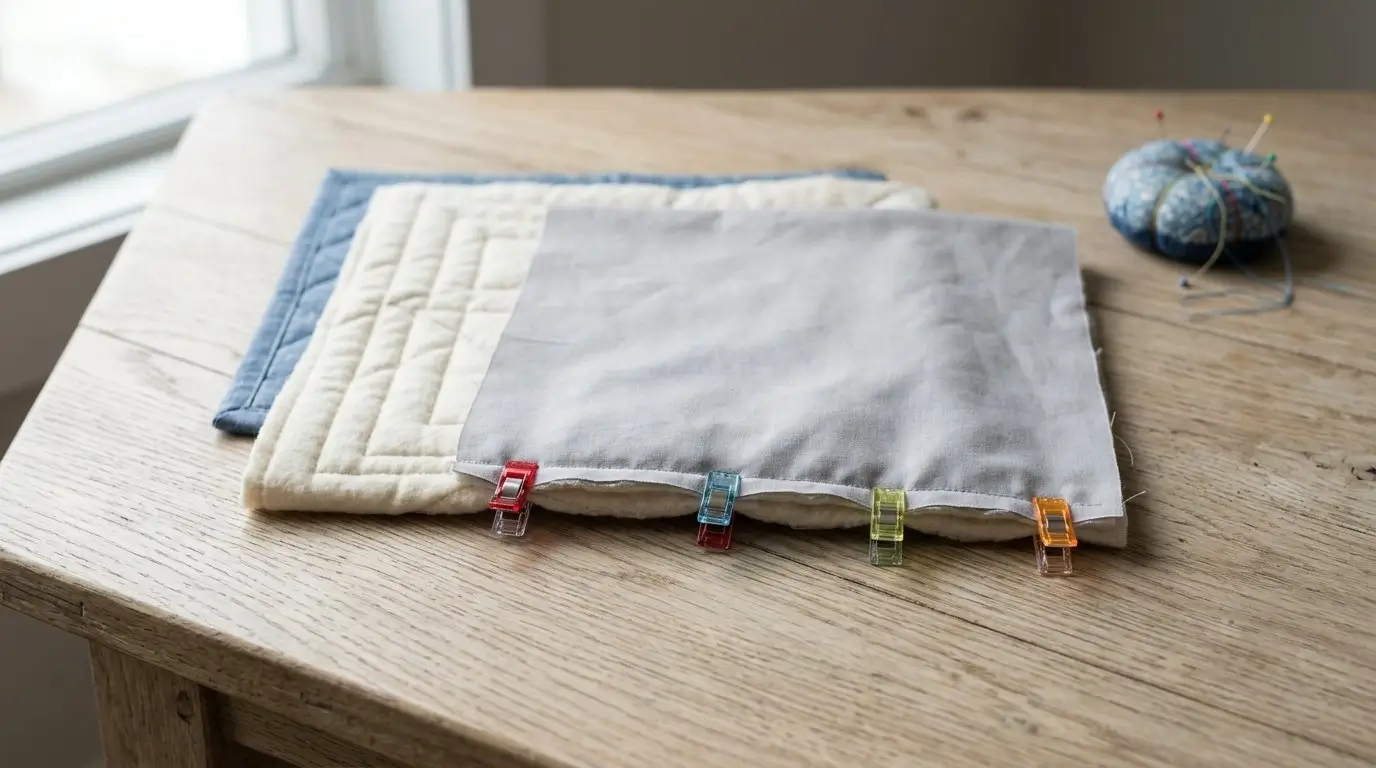
Sewing clips are small, spring-loaded clips designed to hold fabric layers together before stitching. Unlike pins, they do not pierce the fabric. That one difference makes them useful in many situations where pin holes, shifting, bulk, or speed matter.
Use sewing clips when you want to:
- Avoid permanent holes in vinyl, cork, leather, faux leather, laminated cotton, oilcloth, or coated fabric.
- Hold bulky layers such as bag seams, quilt binding, fleece, coat fabric, or folded hems.
- Clip long edges quickly without repeatedly pushing pins through dense layers.
- Keep edges aligned while sewing binding, straps, pockets, or layered panels.
- Work near a serger more safely than with pins, as long as clips are removed before the blade or presser foot.
- Reduce snagging on textured or stretchy fabrics like sweater knits, fleece, and minky.
They are especially popular for bag making, quilting, hemming, binding, knits, craft sewing, and projects with many layers. If you have ever bent pins trying to hold a thick strap, left holes in faux leather, or had a quilt binding shift while sewing, clips can make the setup easier.
That said, sewing clips are not a complete replacement for pins. Pins can be better when you need exact placement inside the fabric area, such as matching darts, fitting a garment on the body, or holding tiny seam intersections away from the edge. Most sewists benefit from keeping both tools nearby.
Sewing Clips vs Pins: Which Should You Use?
The choice between sewing clips and pins depends on the fabric, seam shape, project type, and how precise the placement needs to be. Pins go through the fabric, so they can hold points exactly in place. Clips grip from the edge, so they protect fabric surfaces and handle bulk well.
| Situation | Use Sewing Clips When | Use Pins When |
|---|---|---|
| Thick seams | You are holding bulky layers, straps, quilt binding, fleece, or bag panels. | The fabric is thick but still needs a precise point matched away from the edge. |
| Delicate fabrics | Pin holes may show, snag, or distort the fabric. | You can use very fine pins safely and need more exact placement. |
| Garment fitting | You are clipping hems or edges flat on the table. | You are fitting fabric on a body or dress form and need flexible placement. |
| Slippery layers | Clips help hold edges together before sewing. | You need to pin deeper into the project or baste key points. |
| Curved seams | Small clips can hold gentle curves and binding. | Tight curves, small seam allowances, or notches need fine control. |
| Quilting | You are attaching binding or holding multiple layers at the edge. | You are matching patchwork points or nesting seams precisely. |
| Binding | Clips hold folded binding evenly around quilts, bags, or necklines. | You need to mark or secure a specific interior point. |
| Serger work | Clips can hold edges without risking a pin near the blade, if removed in time. | Avoid pins near the serger blade; if pins are needed, place them carefully away from the cutting path and remove early. |
Sewing clips are often better for edge-based tasks: binding, hems, thick seams, layered bags, and coated fabrics. Pins are often better for precision tasks: garment fitting, pattern matching, darts, pleats, and alignment points away from the edge.
A simple rule: if the fabric surface matters or the layers are bulky, reach for clips first. If the exact point matters more than the edge grip, pins may be the better tool.
Best Projects and Fabrics for Sewing Clips
Sewing clips shine in projects where fabric layers are thick, stiff, coated, stretchy, or awkward to pin. They are also handy when you need to hold a long edge before stitching.
For bag making, clips are useful for tote bags, zipper pouches, wallets, handles, straps, boxed corners, and layered seams. Bag projects often include interfacing, foam, lining, exterior fabric, and folded edges. Clips can hold these layers together without bending pins or making unnecessary holes.
For quilting, clips are especially useful for binding. After folding binding over the quilt edge, you can clip it in place every few inches before sewing. This helps keep the fold even around straight edges and corners. Clips can also hold quilted panels, thick borders, or small quilted accessories before stitching.
For coated and non-woven materials, clips are often the better choice because pin holes may remain visible. This includes:
- Vinyl
- Faux leather
- Leather
- Cork fabric
- Oilcloth
- Laminated cotton
- Waterproof or coated fabrics
These materials do not always recover after being pierced. A pin hole in cotton may disappear into the weave, but a hole in vinyl or cork can remain. Clips avoid that issue because they grip only from the edge.
For stretchy or textured fabrics, clips can help reduce snagging and shifting. Try them with knits, sweater knits, fleece, minky, ribbing, and plush fabrics. Pins can sometimes drag through loops or distort stretch fabrics if placed too tightly. Clips hold the edge without pulling a hole through the material.
For binding on garments, clips can help hold neckline binding, sleeve bands, waistbands, or hems before sewing. For example, if you are sewing knit binding around a neckline, you can clip the quarter points first, then add more clips between them to distribute the binding evenly. You may still use pins for exact matching points, but clips make the edge easier to manage.
How to Use Sewing Clips Correctly
Using sewing clips is simple, but a few habits will give you cleaner results.
Start by aligning the raw edges of your fabric layers. Place the clip so it grips the seam allowance without pulling the fabric out of shape. For straight seams, clips can be spaced farther apart. For curves, slippery fabric, bulky areas, or binding, place them closer together.
You can position clips in two common ways:
- Perpendicular to the edge: Helpful for most seams because the clip is easy to see and remove as you sew.
- Parallel to the edge: Useful when you want to keep the clip away from a narrow seam path or when holding folded binding neatly.
Always remove sewing clips before they reach the presser foot, needle, or serger blade. You should not sew over clips. They are too bulky to pass safely under the foot, and they can interfere with the needle, foot, or cutting blade.
Many sewing clips have a flat base, which helps the fabric sit smoothly on the table or machine bed. Some also include small measurement markings, often used as a quick guide for seam allowances. These markings are helpful, but still check your seam allowance with your machine guide, ruler, or marked plate when accuracy matters.
Practical spacing depends on the project. On a stable straight seam, you may only need clips every few inches. On curves, binding, slippery fabrics, or thick bag seams, add more clips so the layers cannot shift between them.
You can also use clips away from the machine for preparation tasks: holding hems before pressing, keeping binding folded, grouping small cut pieces, securing pattern pieces temporarily at the table, or organizing quilt blocks in order.
Common Mistakes to Avoid
The biggest mistake is trying to sew over sewing clips. Unlike some pins, clips are not meant to pass under the presser foot. Remove each clip before it reaches the needle area. If you are using a serger, remove clips well before they reach the blade.
Another common mistake is using clips when pins would give better placement. Clips only hold from the edge. If you need to match a dart point, secure a pleat in the middle of a garment piece, or align a print motif away from the seam allowance, pins or hand basting may work better.
Avoid forcing large clips into tight curves or tiny seams. Oversized clips can distort small pieces or make curves harder to control. Use smaller clips, finer pins, or a few hand basting stitches when the area is too narrow.
Do not assume clips will prevent all shifting on very slippery fabrics. They help, but fabrics such as satin, lining, or certain knits may still creep as you sew. In those cases, use more clips, shorten the distance between them, try a walking foot if appropriate, or baste the layers first.
Finally, keep clips away from direct iron heat unless the specific clips are rated for heat exposure. Many sewing clips are plastic and can melt, warp, or leave marks if pressed with a hot iron.
What to Look for When Buying Sewing Clips
Good sewing clips do not need to be complicated, but a few features make them easier to use.
Look for clips with:
- A firm grip that holds layers without popping open.
- Smooth edges so they do not snag fabric.
- A flat base to help fabric feed smoothly on the table.
- Visible colors so you can spot and remove them before sewing.
- Seam allowance markings if you like quick visual guides.
- Mixed sizes for different projects.
Small clips are useful for curves, narrow seams, neckline binding, children’s garments, and small craft pieces. Larger clips are better for quilt binding, bag panels, thick hems, bulky seams, and layered projects.
If you sew long hems, quilts, bags, or binding, buy enough clips so you do not have to keep moving the same few clips along the project. Having a generous handful ready makes the process smoother, especially when preparing a full quilt edge or a large tote bag panel.
A mixed pack is often a practical starting point for beginners. You can test which sizes feel best for your sewing style before buying more of one type.
FAQ
Can sewing clips replace pins completely?
Not completely. Sewing clips are excellent for edges, bulky layers, binding, and fabrics that should not be pierced. Pins are still useful for garment fitting, darts, pleats, pattern matching, and precise placement away from the fabric edge.
Are sewing clips better for quilting?
They are very helpful for quilting, especially when attaching binding or holding thick quilted layers at the edge. Pins may still be better for matching patchwork points or securing seams that need exact alignment before stitching.
Can you use sewing clips with a serger?
Yes, sewing clips can be useful with a serger because they hold edges without placing pins near the blade. Remove each clip before it reaches the presser foot or cutting blade. Never let a clip feed into the serger.
Do sewing clips leave marks on fabric?
They usually do not leave holes because they do not pierce the fabric. However, very delicate, plush, or pressure-sensitive fabrics may show temporary clamp marks. Test on a scrap first if the fabric surface is important.
What size sewing clips should beginners buy?
Beginners usually do well with a mixed set. Small clips work for curves and narrow seams, while larger clips are useful for bags, quilts, hems, and bulky layers. Choose clips with a firm grip, smooth edges, and visible colors.